


Your Mechanic Says “Hydraulic Pump.” Is He Right?

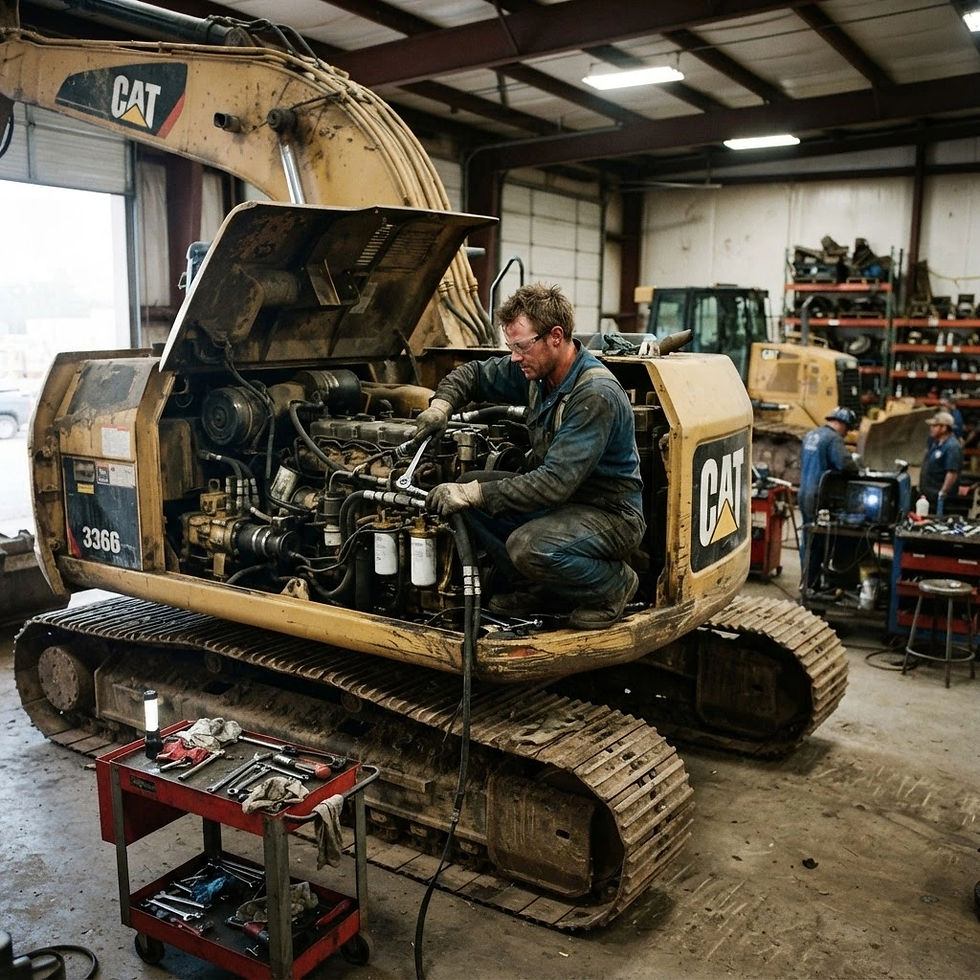
There are few phrases an excavator owner wants to hear less than:
“It looks like the hydraulic pump.”
Because everyone knows what usually comes next.
A big number.
Sometimes a very big number.
The pump gets blamed.
The quotation arrives.
The machine is stripped.
The new pump gets ordered.
And then, somewhere in the middle of this increasingly expensive drama, somebody discovers that the pump wasn't actually the problem.
Congratulations.
You've just spent a small fortune fixing something that wasn't broken.
Welcome to excavator ownership.
Hydraulic problems are bloody good at lying
Here's the problem with hydraulic systems:
Different problems can produce remarkably similar symptoms.
Slow hydraulics.
Weak digging.
Poor travel performance.
Loss of power.
Overheating.
Strange noises.
Functions that work intermittently.
A machine that seems fine when cold but becomes useless once the oil gets hot.
All of these symptoms can point you toward the hydraulic pump.
But they can also be caused by:
Hydraulic valves
Relief valves
Pilot systems
Hydraulic cylinders
Control valves
Blockages
Contaminated oil
Suction problems
Leaking hoses
Faulty sensors
Electrical control issues
Filters
Seals
Incorrect oil
And a whole collection of other expensive possibilities
In other words:
A hydraulic symptom is not a diagnosis.
It's a clue.
“The pump is weak.”
Okay.
Why?
That's the question.
Because “weak pump” is sometimes a diagnosis.
And sometimes it's a mechanic's version of:
“Something in here isn't working properly and the pump is an expensive-looking suspect.”
The hydraulic system is a system.
That's worth remembering.
The pump doesn't operate in isolation.
It produces flow and pressure.
That flow and pressure then travel through a network of valves, pipes, hoses, controls and actuators.
If something downstream is restricting flow, leaking internally or failing to control pressure correctly, the symptoms can look very much like a pump problem.
And if you replace the pump without identifying the underlying cause?
You may have just installed a very expensive new victim.
The most expensive mistake is replacing parts by guesswork
Imagine this.
Your excavator suddenly becomes slow.
The bucket struggles.
The boom feels weak.
The operator says:
“The hydraulics aren't right.”
The mechanic looks at it.
“Probably the pump.”
You order a replacement.
The pump costs R150,000.
You spend another R20,000 fitting it.
You fire up the machine.
Same problem.
Now what?
The old pump may have been perfectly healthy.
And worse:
Whatever actually caused the original problem may still be sitting there waiting to destroy your new pump.
That's how a R150,000 problem becomes a R300,000 problem.
Before you buy a pump, test the system
This sounds obvious.
But it is worth saying anyway:
Test before replacing.
Hydraulic diagnosis should involve actual measurements wherever possible.
Pressure.
Flow.
Temperature.
Leakage.
Performance under load.
The exact tests depend on the machine and hydraulic system, but the principle remains the same.
Don't diagnose a hydraulic system exclusively by listening to it and giving the pump a dirty look.
Measure.
Pressure and flow are not the same thing
This is where things get interesting.
A hydraulic pump can have a problem with its ability to produce flow.
It can also have a problem maintaining pressure.
Those aren't necessarily the same problem.
And understanding the difference can point you in a completely different direction.
A machine that is slow may have insufficient flow.
A machine that is weak under load may have insufficient pressure.
But there can also be internal leakage, control-valve problems, relief-valve issues or other faults producing similar symptoms.
That's why “it's slow” isn't enough information to order a pump.
What does the operator actually mean by “weak”?
This is one of the most useful questions you can ask.
Because operators use words like:
Weak.
Slow.
Lazy.
Struggling.
No power.
Not pulling.
But those descriptions aren't technical diagnoses.
Ask better questions.
Does the machine:
Move slowly?
Lose power only when hot?
Struggle only under load?
Have one function that's weak?
Have every hydraulic function affected?
Have normal travel but weak digging?
Have a problem with boom but not bucket?
Make an unusual noise?
Overheat?
Improve when the engine speed increases?
Work normally for a while before deteriorating?
Now you're getting somewhere.
One bad function tells you something
Suppose the bucket curl is weak.
But the boom works normally.
The arm works normally.
The swing works normally.
Travel works normally.
Would you immediately condemn the main hydraulic pump?
Probably not.
If multiple functions are affected in a consistent way, the pump becomes more interesting.
If one particular function is behaving badly while everything else is fine, you may need to investigate other parts of the hydraulic circuit.
That's the beauty of diagnosis.
The symptoms contain information.
You just have to listen to them.
“It works fine when it's cold.”
Ah.
Now you've got an interesting clue.
A hydraulic system that performs reasonably when cold but deteriorates as the oil heats up can point toward issues involving internal leakage, clearances, seals, valves, oil viscosity or other heat-related effects.
Again:
It doesn't automatically mean the pump is bad.
But it tells you something has changed as the operating temperature changes.
That's useful information.
And useful information is exactly what you need before spending serious money.
Hydraulic oil isn't just hydraulic oil
Here's another boring little detail that can cause very expensive problems.
Oil matters.
The wrong oil.
Contaminated oil.
Degraded oil.
Water contamination.
Incorrect viscosity.
Particles in the system.
All of these can affect hydraulic performance and component life.
And contamination is particularly nasty.
Because hydraulic systems don't appreciate having microscopic pieces of metal circulating through their carefully engineered components.
It's a bit like putting sand into your car's engine and then wondering why it sounds unhappy.
Filters are not optional decoration
A blocked or restricted filter can create problems.
A neglected filter can allow contamination to circulate.
A suction-side restriction can create conditions that cause cavitation.
And cavitation can damage hydraulic components.
So before condemning a pump, you need to know what the pump has been dealing with.
Because if the system is contaminated and you simply install another pump...
you may be feeding a new pump into the same murder machine.
And that's not a particularly good maintenance strategy.
Cavitation: the hydraulic pump's version of being slowly murdered
Cavitation occurs when the pump isn't getting the conditions it needs on its inlet side.
The result can be damaging.
You may hear unusual whining or growling.
Performance can deteriorate.
Components can become damaged.
And once again, the temptation is to say:
“The pump is noisy. Replace the pump.”
But why is the pump noisy?
That's the important question.
A restriction.
A suction problem.
Low oil level.
Incorrect oil.
Air entering the system.
Other issues.
If you don't fix the cause, the replacement pump may suffer the same fate.
The relief valve is another suspect
Hydraulic systems use relief valves to protect components from excessive pressure.
If a relief valve isn't functioning correctly, it can affect machine performance.
And because the symptoms can involve pressure and power, it can sometimes look like a pump problem.
This is why proper diagnosis matters.
If the pump is producing the required pressure and flow but the system isn't using it correctly, replacing the pump isn't going to magically solve the problem.
You're essentially changing the engine because the gearbox is broken.
Don't forget the cylinders
Here's another classic.
A hydraulic cylinder can develop internal leakage.
Externally, everything may look perfectly fine.
No massive oil leak.
No puddle.
No dramatic failure.
But internally, oil can bypass the piston seals.
The cylinder may lose holding ability or performance.
Depending on the application and symptoms, that can make the machine appear weak.
Again:
The symptom isn't the diagnosis.
And then there are hydraulic valves
Control valves regulate where hydraulic oil goes and under what conditions.
A valve that isn't functioning properly can cause all sorts of strange behaviour.
Slow functions.
Weak functions.
Functions that behave differently from one another.
Heat generation.
Pressure problems.
So if someone says:
“Hydraulic pump.”
the correct response isn't necessarily:
“Okay, where do I sign?”
It might be:
“What tests did you perform?”
That's not being difficult.
That's being financially responsible.
The R150,000 question
Before spending R150,000 on a pump, ask:
“What evidence tells you the pump has failed?”
Not:
“Do you think it's the pump?”
Ask:
What pressure readings did you get?
What flow readings did you get?
Under what conditions?
Was the oil at operating temperature?
Were the filters checked?
Was the hydraulic oil inspected?
Were there signs of contamination?
Was the relief system checked?
Are all hydraulic functions affected?
Is there evidence of internal leakage?
Could there be a control or pilot issue?
Those questions don't guarantee a correct diagnosis.
But they dramatically improve the quality of the conversation.
Sometimes the pump really is fucked
Let's not get carried away.
Sometimes the pump is absolutely the problem.
Hydraulic pumps wear.
They fail.
Bearings fail.
Rotating groups wear.
Components become damaged.
Internal clearances increase.
Contamination destroys things.
And eventually the pump says:
“I've had enough.”
When the evidence points to pump failure, replace it.
That's what we're here for.
But diagnosis should come before procurement.
Because once you've identified the actual problem, you can make an intelligent decision about what to buy.
New OEM isn't automatically the answer either
If you've established that the pump has failed, you've reached the next question:
What should you replace it with?
Brand-new OEM?
Used OEM?
Refurbished OEM?
Quality aftermarket?
There isn't one universal answer.
It depends on:
Machine age
Machine value
Application
Expected remaining service life
Budget
Availability
Required reliability
Cost of downtime
If you're running a relatively new machine on a critical mining contract, the economics may point one way.
If you're running a 15-year-old excavator on a less intensive application, the answer may be completely different.
The objective isn't to sell the most expensive component.
The objective is to find the most sensible solution.
This is where a good parts supplier earns their money
A parts supplier shouldn't simply ask:
“How much can I charge you for a pump?”
They should ask:
“Are you sure you need a pump?”
That's an important distinction.
At Vikfin, we sell used OEM and refurbished OEM excavator components.
But we also understand that buying a part is only useful if it solves the problem.
If you tell us:
“I need a hydraulic pump.”
we're going to want to know:
What machine?
What serial number?
What pump?
What part number?
What symptoms?
What has been tested?
What's the application?
Because the last thing anybody needs is a R100,000 component arriving at the workshop only to discover that the actual problem was a blocked filter.
Diagnosis first. Parts second.
That's the rule.
Not because it's clever.
Because it's cheaper.
A few hours of proper diagnosis can save you tens or hundreds of thousands of rand in unnecessary parts and labour.
And here's the irony:
The better your diagnosis, the faster we can help you.
Give us accurate information and we can identify the correct component, check compatibility and get the sourcing process moving.
Give us:
“It's a Hitachi and the hydraulics are fucked.”
and we're going to have a slightly harder time.
Although, to be fair, we've heard worse.
Don't turn your excavator into a parts lottery
The process shouldn't be:
Symptom → Guess → Buy part → Fit part → Pray.
It should be:
Symptom → Diagnose → Confirm → Identify component → Source → Fit → Test.
That's the difference between fixing a machine and gambling with one.
And when the machine is worth several million rand, gambling isn't really a business strategy.
Your mechanic might be right
He might.
The hydraulic pump may genuinely be the problem.
But before you spend serious money, make him prove it.
Not because you don't trust him.
Because good mechanics don't guess when they can test.
And good excavator owners don't buy expensive components simply because somebody pointed at the pump and said:
“Probably that.”
Because the cheapest pump is the one you don't have to buy twice
That's the real lesson.
Don't start with:
“Where can I get the cheapest hydraulic pump?”
Start with:
“What is actually wrong with my machine?”
Once you know that, the parts question becomes much easier.
And that's where Vikfin comes in.
Quality used OEM and refurbished OEM excavator components.
Technical knowledge.
Compatibility checks.
Practical advice.
And a simple objective:
Getting You Back to Work Fast.
Because the best hydraulic pump in the world is useless if it isn't the right pump.
And the cheapest pump in the country is bloody expensive if you didn't need a pump in the first place.
Diagnose first.
Buy second.
Get the machine working.



Comments